Complete Guide: How to Register an LLC in Moldova in 2026
How to register an LLC in Moldova: required documents, steps, costs from 2,000 MDL, ~3-day timeline, share capital, and tax advantages. Full company formation guide.
 DeschideCompanie
 A practical guide to Moldova's CAEM-2 classifier: how to choose the right activity code and how it affects your company's taxes and licensing.
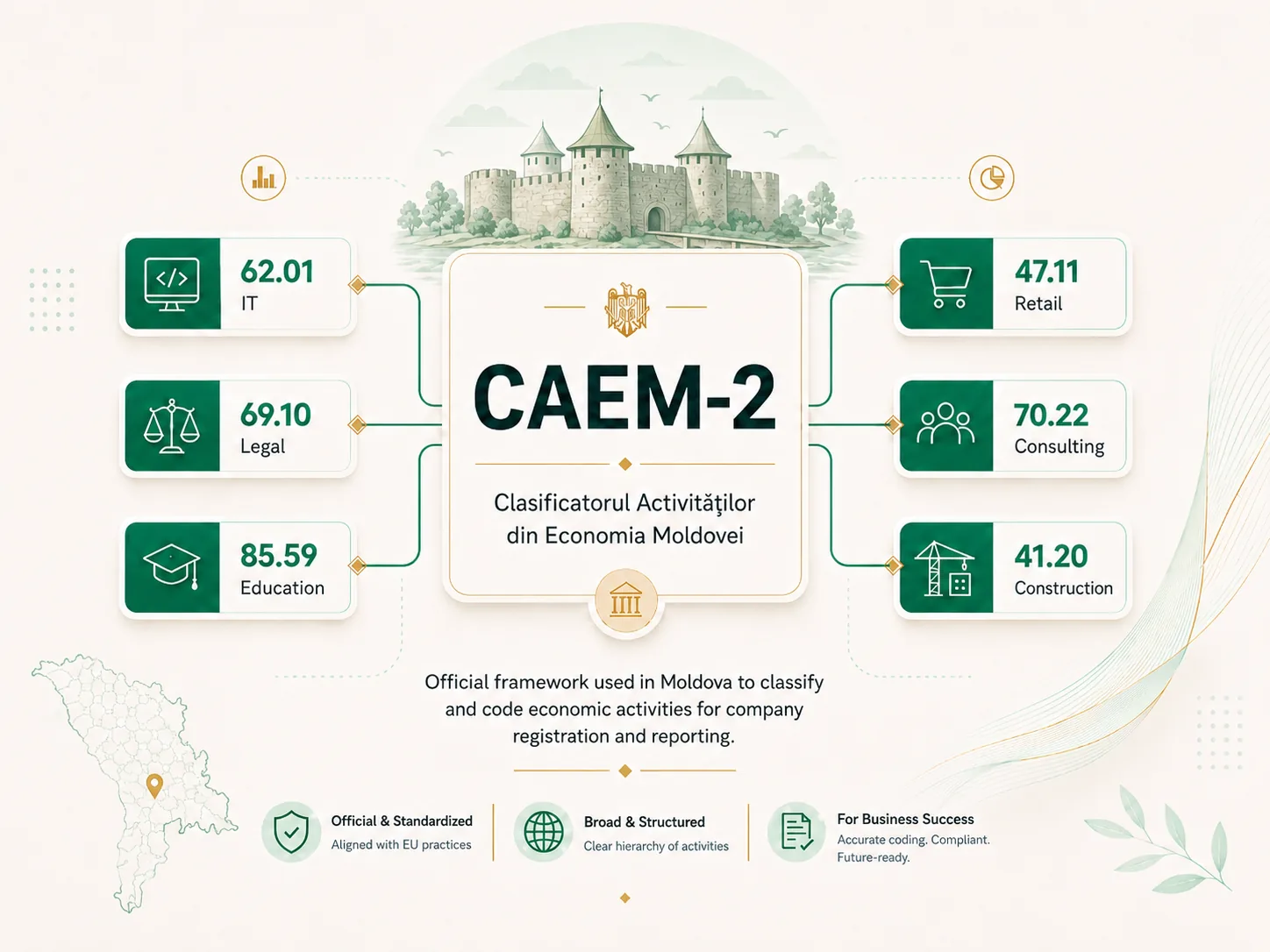
Every company registered in the Republic of Moldova is assigned a CAEM code — a numeric identifier that describes its primary economic activity. While it may seem like a minor bureaucratic detail, choosing the right CAEM code directly influences your tax regime, licensing requirements, and how government institutions view your business.
CAEM-2 (Classifier of Economic Activities of Moldova, Revision 2) is the official system for coding economic activities, approved by BNS Order No. 28 of 07.05.2019. It is based on the European NACE Rev.2 and international ISIC Rev.4 classifications.
The classifier follows a hierarchical structure:
For example, code 62.01 means “Computer programming activities” and belongs to Section J — Information and Communication.
Certain CAEM codes qualify for special tax regimes. IT sector companies (codes 62.xx and 63.xx) may apply for sector-specific tax benefits. Choosing the wrong code could mean missing out on these advantages.
Some economic activities require special licenses or permits. For example:
If your CAEM code doesn’t match your actual activity, you risk fines or inability to obtain the necessary license.
The National Bureau of Statistics uses CAEM codes to generate economic reports. The correct code ensures your company is classified in the right sector.
In public tenders, your CAEM code is checked to confirm that your company has the competence to deliver the requested services. An inappropriate code can lead to disqualification.
Think about what your company will primarily do — not everything it could theoretically do. The primary CAEM code should reflect your main source of revenue.
Use our CAEM search tool to find the right code. You can search:
Registration requires 4-digit codes (class level). For example, not “62” (which is just the division), but 62.01 — the specific activity.
You can register multiple CAEM codes — one primary and several secondary. Secondary activities give you flexibility, but don’t overdo it: choose only those relevant to your actual business plans.
Code too general. Some entrepreneurs select a group code (3 digits) instead of a class (4 digits). Registration requires the full code.
Code doesn’t match the activity. Choosing a code “at random” can create problems when obtaining licenses or during tax inspections.
Too many secondary codes. Adding dozens of secondary codes brings no benefit and may attract scrutiny from regulatory authorities.
Not updating the code. If your company’s activity changes, the CAEM code should be updated through the statutory documents amendment procedure.
| Activity | CAEM Code | Section |
|---|---|---|
| Software development | 62.01 | J — Information and communication |
| Restaurant | 56.10 | I — Accommodation and food service |
| Online retail | 47.91 | G — Wholesale and retail trade |
| Management consulting | 70.22 | M — Professional activities |
| Freight transport | 49.41 | H — Transportation and storage |
| Hair salon | 96.02 | S — Other service activities |
Choosing the right CAEM code is just the first step. The DeschideCompanie team guides you through the entire registration process:
Don’t let a bureaucratic detail complicate your business. Contact us for a free consultation or explore the full classifier on our CAEM page.
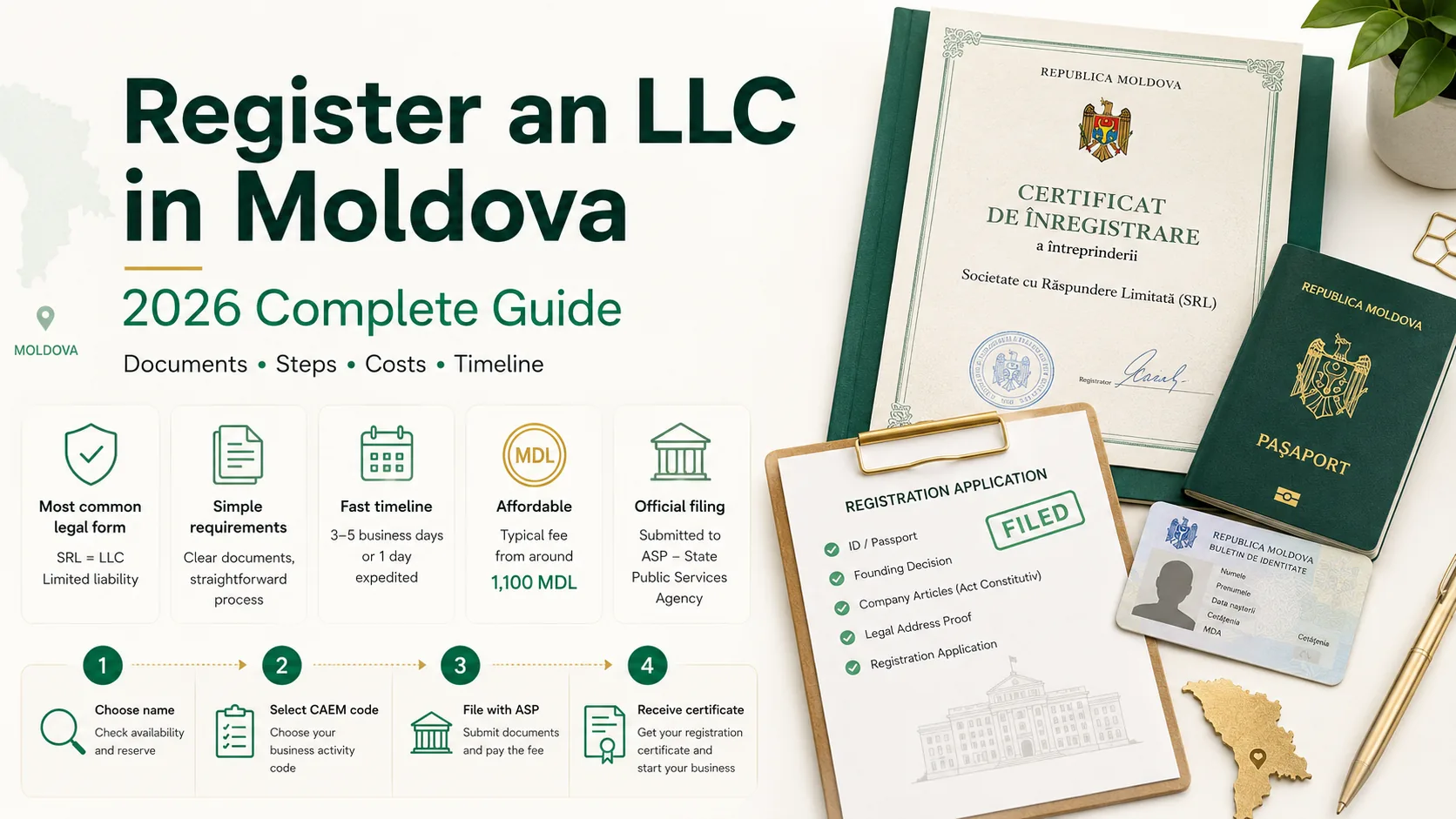
How to register an LLC in Moldova: required documents, steps, costs from 2,000 MDL, ~3-day timeline, share capital, and tax advantages. Full company formation guide.

What Moldova's 2026 'European Economy, Efficient State' reform plan changes for registering a company — and why it is already a fast, remote-friendly place to start.

What a Romanian company actually adds, which reasons stopped being true in 2026, and what an SRL costs — whether you are starting out or already trading.