Complete Guide: How to Register an LLC in Moldova in 2026
How to register an LLC in Moldova: required documents, steps, costs from 2,000 MDL, ~3-day timeline, share capital, and tax advantages. Full company formation guide.
 DeschideCompanie
 What a Romanian company actually adds, which reasons stopped being true in 2026, and what an SRL costs — whether you are starting out or already trading.
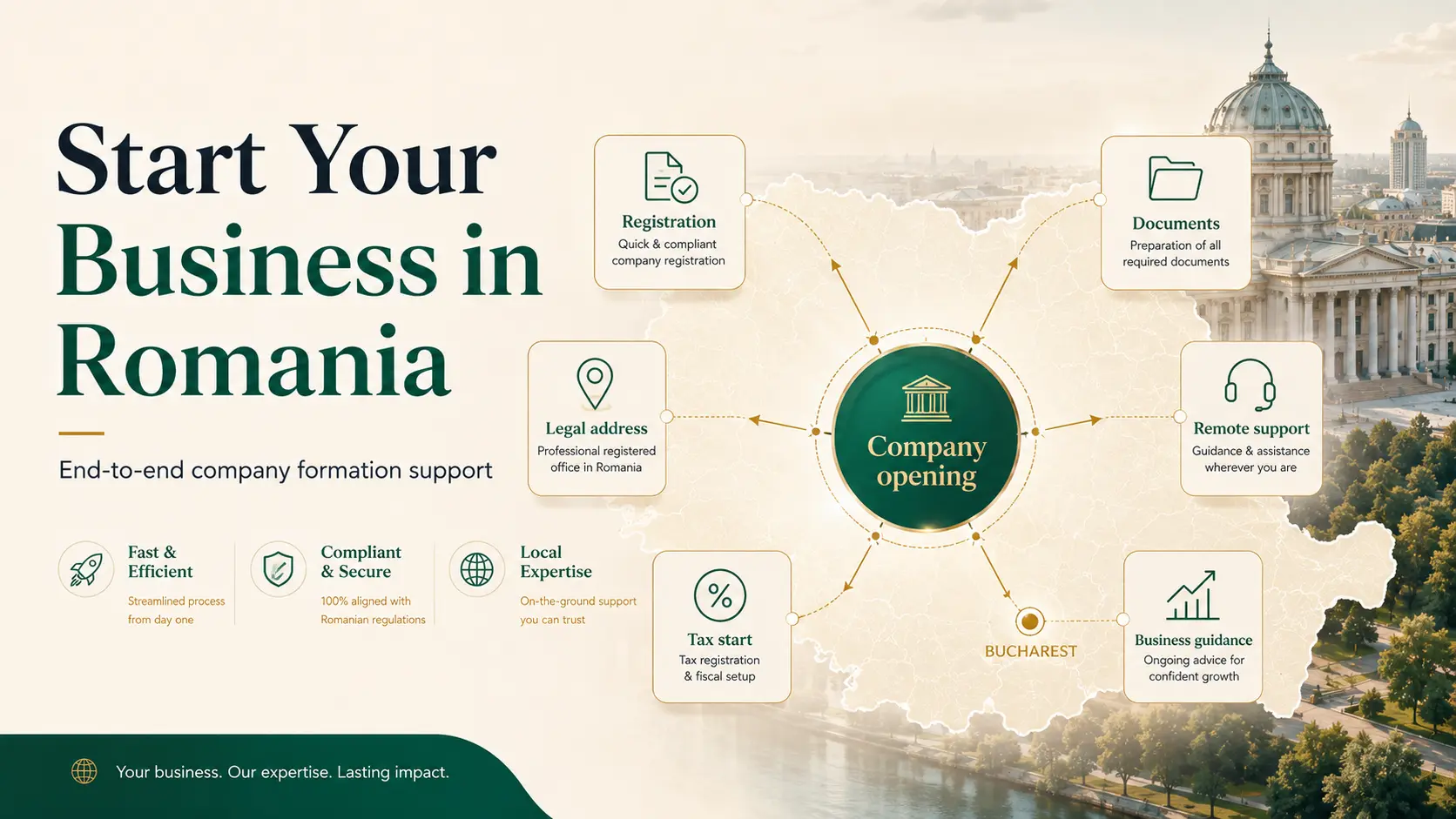
The conversation comes from two directions.
The first: a client with a Moldovan company starts winning European customers, the orders get bigger, and then somebody on the other side asks a question they cannot answer well — do you have an EU entity?
The second comes from people who have not registered anything yet. They have a serious plan, the customers they are aiming at are in Europe, and they ask outright where they should start: Chisinau, Bucharest, or both.
Until now our honest response was that we would ask around and get back to them. That changes today. We have partnered with an incorporation firm in Bucharest, and we can now put clients in front of people who set up Romanian companies for a living.
This article separates the real reasons from the ones that stopped being true, and puts the actual cost of a Romanian SRL in 2026 on the table.
Most of what gets said about “access to the European market” describes the situation of a few years ago. Four things you already have without a Romanian company:
Customs duties. Moldova has a Deep and Comprehensive Free Trade Area with the European Union. Most Moldovan goods enter the EU without customs duties (European Commission).
Transit formalities. Since 1 November 2025 Moldova is a party to the Convention on a common transit procedure and to the Convention on the simplification of formalities in trade in goods, and it uses NCTS, the same electronic system as the member states, Türkiye, Serbia, the United Kingdom and Ukraine (European Commission).
Euro payments. Moldova has been operational in SEPA since 6 October 2025. Euro transfers settle on the same conditions as inside the union (European Commission).
EU trademarks. Any person or company can own an EU trade mark, wherever they are based. Applicants without an establishment in the EEA need a professional representative in proceedings before the Office, not an EU company (EUIPO).
If somebody is selling you a Romanian SRL on one of those four grounds, they are selling you something you already have.
What remains comes down to one thing: being established in a member state rather than trading with one. That difference is real.
You need no existing company to start in Romania, and no local partner. You can be the sole shareholder and the administrator, without EU citizenship and without residency.
The useful question is not which jurisdiction sounds better, but where your customers and your people are.
If you sell services or software to EU companies and the team is small and distributed, the Romanian entity may well be the first one. The EU VAT number removes a conversation you would otherwise have with every single customer.
If the team, the cost base and the delivery are in Moldova, you usually start here and add Romania when a customer actually asks for an EU-established supplier — not before. A Romanian company opened “just in case” costs accounting, filings and one employee every month it produces nothing.
If the business is IT, run the numbers on IT Park first: the 7% regime changes the arithmetic materially, and the calculator will do it with your figures.
Worth knowing before you decide, rather than after.
Share capital. Law 239/2025, in force since 18 December 2025, requires a minimum of RON 500 at incorporation. A second threshold catches people later: at net turnover above RON 400,000, the capital has to be raised to at least RON 5,000, by the end of the financial year following the one in which the threshold was passed (Portal Legislativ).
Registration. Companies go on the register at the ONRC. The registrar rules on the application within one working day of filing; if the file is incomplete you get a period of up to 15 calendar days to complete it (Law 265/2022). Realistically the whole cycle — name reservation, drafting, supporting documents — runs three to ten working days.
Micro-enterprise tax. From 2026 there is a single rate of 1% of revenue, regardless of activity code. The ceiling has dropped to EUR 100,000, that is RON 509,850 at the 5.0985 rate of 31 December 2025. The company must have at least one full-time employee, and a shareholder holding more than 25% cannot hold several micro-enterprises. Banking, insurance and capital markets, gambling and oil and gas extraction stay outside the regime. The tax is declared and paid quarterly (ANAF).
Above the ceiling. You move to the 16% profit tax from the quarter in which you passed EUR 100,000. It is not a change from the following year, but from that quarter.
Taking money out. Dividends are taxed at 16% for distributions made from 1 January 2026, up from 10% (Law 141/2025). For a shareholder who is a tax resident of Moldova, the treaty between the two states caps the tax at 10% of the gross amount, provided you give the paying company a tax residence certificate (ANAF). The 10% health contribution concerns Romanian tax residents whose dividend and other income reaches six gross minimum salaries, RON 24,300 in 2026.
VAT. The standard rate is 21%, with a reduced 11% rate on a defined list. Registration becomes mandatory above RON 395,000 of turnover.
Reporting. B2B invoices go through RO e-Factura, and the SAF-T informative return (D406) has been mandatory for small taxpayers too since 1 January 2025 (ANAF). In practice you need competent monthly accounting from month one, not from your first customer.
Ownership and residency. You do not need to be an EU citizen or a Romanian resident to hold the shares and be the administrator. But owning a company gives you no right to live or work in Romania — that is a separate immigration track with its own investment and job-creation thresholds.
We do not register companies in Romania, and we are not going to pretend otherwise. What we do is introduce you to a firm in Bucharest that has been doing Romanian incorporations long enough to handle the awkward files as well as the simple ones.
You tell us what you are setting up and roughly what it is for. We put you in front of the right people. They take the registration from there, and we stay available for the Moldovan side of whatever you build.
We are not publishing their name here. That is deliberate. The introduction is a personal one and we would rather make it properly than turn it into a directory listing.
Do you already run a Moldovan company and has Europe started asking where you are established? Or are you at the start and trying to choose where to begin? We have both conversations often.
Write to us with what you sell, who buys it and where, and we will tell you whether a Romanian entity is worth the overhead in your case. Sometimes the answer is that it is not, and we will say so.
For the Moldovan side of the picture, our corporate services page covers what we handle ourselves. And if you are coming the other way — a Romanian investor looking at Moldova — we wrote about that here.
No. We register companies in Moldova. For Romania we introduce you to an established incorporation firm in Bucharest that we work with, and they handle the registration and the filings. Tell us what you are setting up and we will make the introduction.
Yes. You need neither an existing company nor a local partner. A Moldovan citizen can be the sole shareholder and the administrator of a Romanian SRL. The real question is not whether you can, but where your customers and your people are — if the team and the delivery sit in Moldova, you usually start there and add Romania when an EU customer actually asks for a supplier established in the union.
No. Moldova has been operational in SEPA since 6 October 2025, and euro transfers settle on the same conditions as inside the EU. Customs duties are not a reason either: the DCFTA already removes most of them, and since 1 November 2025 Moldova is a party to the Common Transit Convention. The reasons that hold up are about being established in the EU, not about payments or customs.
Under Law 239/2025, in force since 18 December 2025, a newly incorporated SRL needs at least RON 500. Companies with net turnover above RON 400,000 in the previous financial year must hold at least RON 5,000, and the increase has to be made by the end of the following financial year.
The micro-enterprise rate is 1% of revenue, a single rate from 2026 regardless of activity code. The ceiling is EUR 100,000, that is RON 509,850, down from EUR 250,000. The condition that catches people most often: the company must have at least one full-time employee, and a shareholder holding more than 25% cannot hold several micro-enterprises. Above the ceiling the 16% corporate profit tax applies from the quarter in which you crossed it.
16% on distributions made from 1 January 2026. For a shareholder who is a tax resident of Moldova, the double tax treaty between the two states caps the tax at 10%, provided a tax residence certificate is given to the paying company. The 10% health contribution concerns Romanian tax residents whose income passes six gross minimum salaries.
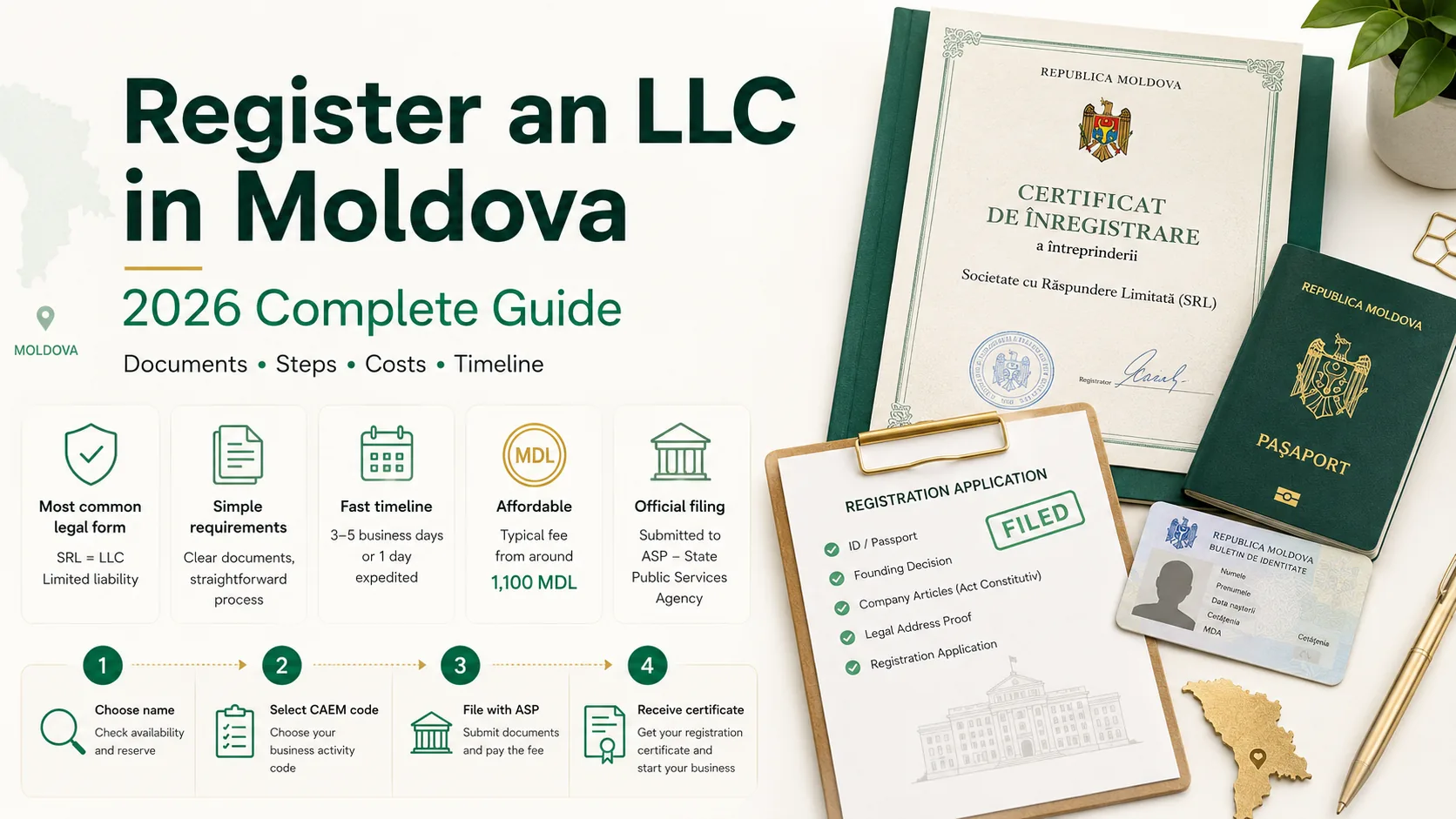
How to register an LLC in Moldova: required documents, steps, costs from 2,000 MDL, ~3-day timeline, share capital, and tax advantages. Full company formation guide.
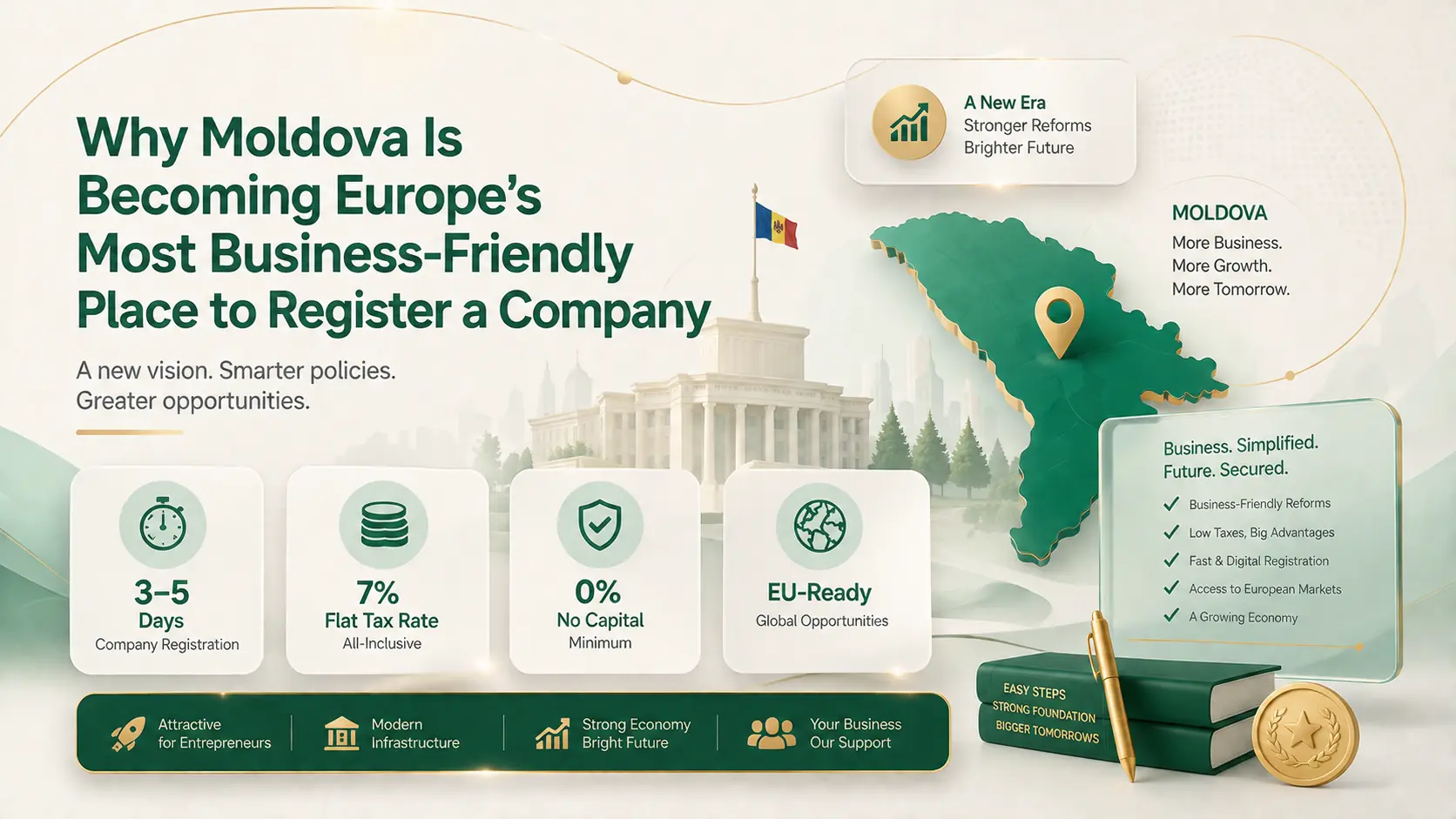
What Moldova's 2026 'European Economy, Efficient State' reform plan changes for registering a company — and why it is already a fast, remote-friendly place to start.
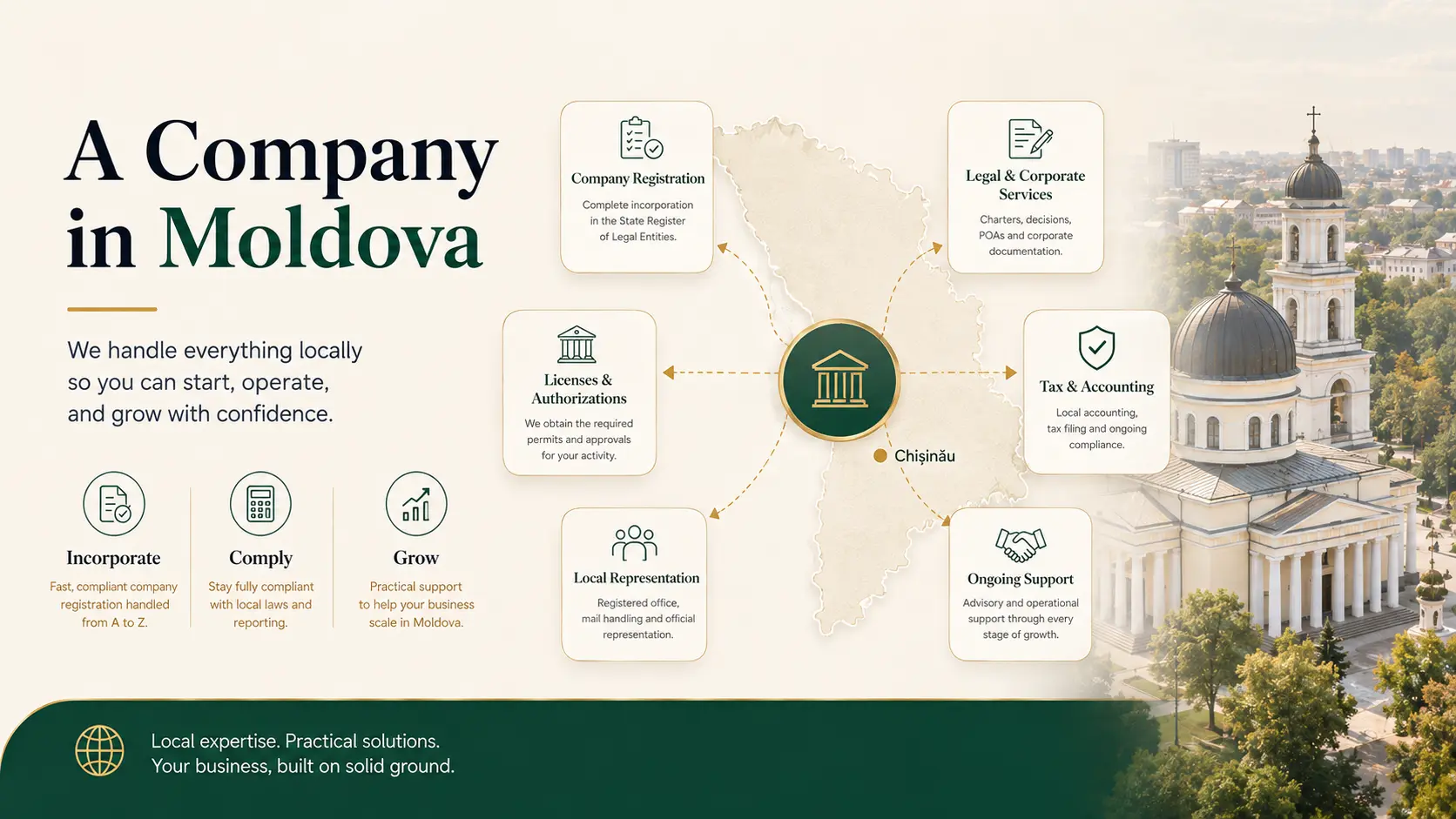
What a Moldovan company gives a Romanian founder, what registering one involves — no apostille, a notarised power of attorney is enough — and what it does not solve.