Complete Guide: How to Register an LLC in Moldova in 2026
How to register an LLC in Moldova: required documents, steps, costs from 2,000 MDL, ~3-day timeline, share capital, and tax advantages. Full company formation guide.
 DeschideCompanie
 What a Moldovan company gives a Romanian founder, what registering one involves — no apostille, a notarised power of attorney is enough — and what it does not solve.
Ask a Romanian entrepreneur about Moldova and the answer comes fast: small market. Two and a half million people, so there is nothing to do there.
That is an accurate measurement of the wrong thing. Almost nobody sets up in Moldova to sell to Moldovans. They set up here because the work gets done here and gets sold somewhere else — and that somewhere else is, more often than not, Romania. In 2025, 29.6% of everything Moldova exported went to Romania, more than three times the next destination (National Bureau of Statistics).
So the trade route is not news. What changed in the last year is the plumbing around it.
Three things, all since the second half of 2025, all with a direct effect on a Moldovan company that works with Europe.
Euro payments. Moldova has been operational in SEPA since 6 October 2025. Euro transfers settle on the same conditions as inside the union, so a Moldovan account no longer behaves like an account outside it (European Commission).
Goods in transit. Since 1 November 2025 Moldova is a party to the Convention on a common transit procedure and uses NCTS, the same electronic system as the member states, Türkiye, Serbia, the United Kingdom and Ukraine (European Commission).
Accession. Screening was completed in September 2025, the first negotiating cluster — fundamentals — was opened on 15 June 2026, and the external relations cluster on 14 July 2026 (Council of the EU).
Treat the accession calendar as direction rather than promise: timelines slip and there is nothing to build on them. What matters in practice is something else — regulation is converging on the acquis, so what you set up here now is less likely to need rebuilding in a few years.
The substance comes from Moldova setting its own tax and trade policy. That position has concrete consequences.
With a Romanian passport you are a non-resident founder in Moldova — but the non-resident founder with the shortest route. Here is the shape of it.
You do not need a local partner. You can own 100% of the share capital and be the administrator yourself. There is no minimum share capital to fund and no residence permit required simply to own the company.
You do not need to travel, and you do not need an apostille. Documents issued by Romanian authorities are recognised in Moldova without superlegalisation or apostille, under Article 22 of the 1996 treaty between the two states on legal assistance in civil and criminal matters, ratified in Romania by Law 177/1997 (Embassy of Moldova in Romania). A power of attorney drawn up before a Romanian notary is enough for a representative to file the whole thing. We set out how the power of attorney route works in detail.
The file. Your passport, the founding decision and articles of incorporation drafted in Romanian, the registration application, and a beneficial owner declaration under Law 308/2017. If the founder is a Romanian company rather than an individual, add an extract from the Trade Register and the company’s constituent documents.
A legal address in Moldova. Every company needs a registered office. We provide one, so you are not signing a lease before you have a company to sign it with.
An IDNP. Foreign founders often need a Moldovan personal identification number for certain steps. Our corporate services page sets out where it fits and what it costs.
Timing. State registration is days. End to end, from a few days to about a week, depending on how quickly the documents and the power of attorney are drawn up.
The bank account is separate, and slower. Some banks accept a representative signing under power of attorney, others want the administrator present. This is the step worth planning around, and we go through it in the guide to opening a business account as a non-resident.
Before any of it, you can check whether your company name is available with our name checker and find the right activity code with the CAEM classifier. Both are free and neither needs an account.
Worth saying as plainly as the good part.
A Moldovan entity does not make you a company established in the European Union. A VAT number valid in VIES, EU public tenders and EU funding all stay tied to an entity in a member state — something your Romanian company already does and the Moldovan one does not replace.
Goods leaving Moldova for the EU remain imports. The DCFTA removes the duties on most of them, and transit has been much simplified since 1 November 2025, but the customs border is still there.
And two jurisdictions mean two sets of accounts, two sets of filings and an obligation to keep transactions between related companies at market prices, verifiable by both tax administrations. That cost starts in month one, whatever the new entity produces.
The Romanian company stays exactly where it is. What you do here is an addition.
We wrote about the Romanian side of the picture — what a Romanian company genuinely adds and what an SRL costs in 2026 — here.
Tell us what the business does, whether you will employ people here, and whether the work is IT or something else. Those three answers determine almost everything: which tax regime fits, whether IT Park is worth pursuing, and how the file should be built.
You can see everything we handle on the corporate services page. If you would rather just describe the situation and get a straight answer about whether Moldova makes sense for you, write to us. Sometimes the answer is that it does not, and we will tell you that too.
Yes. Moldova sets no citizenship or residency requirement for founding a company. You can hold 100% of the share capital and act as administrator at the same time, and you do not need a Moldovan residence permit to own the business.
No. Documents issued by Romanian authorities are recognised in Moldova without superlegalisation and without an apostille, under Article 22 of the 1996 treaty between the two states on legal assistance in civil and criminal matters. A power of attorney drawn up before a Romanian notary is enough. This is the step that slows other foreign founders down and it does not apply to you.
No. With a notarised power of attorney, a representative in Moldova files the whole registration for you. State registration itself takes up to 72 hours once the file is complete. The bank account is the step that sometimes still requires you in person, depending on the bank.
From a few days to about a week, depending on how quickly the documents and the power of attorney are drawn up. State registration itself is a matter of days, and without the apostille the document chain is considerably shorter than it is for founders from outside Romania.
It lets companies in IT, the creative industries and R&D settle most of their tax with a single payment calculated on revenue. Profit tax, the income tax on salaries, payroll contributions to the social and medical funds, road and real estate tax and a range of local charges are all covered by the 7%. VAT is not, and is handled separately. Qualifying means 70% or more of revenue coming from the activities named in Article 8 of Law 77/2016.
Income tax is deferred for as long as no dividends are distributed, on profit earned in the 2023–2026 fiscal periods by micro, small and medium enterprises. It becomes payable on distribution, at 12%. The deferral does not apply to financial and insurance activities, nor to trading companies that exceed both 49 employees and MDL 50 million in turnover or assets.
No. Nothing in Moldovan law requires it and nothing in Romanian law is triggered by opening here. The Romanian company stays where it is and the Moldovan entity is an addition. The rule to keep in mind is that transactions between related companies have to be priced at market value, in both jurisdictions.
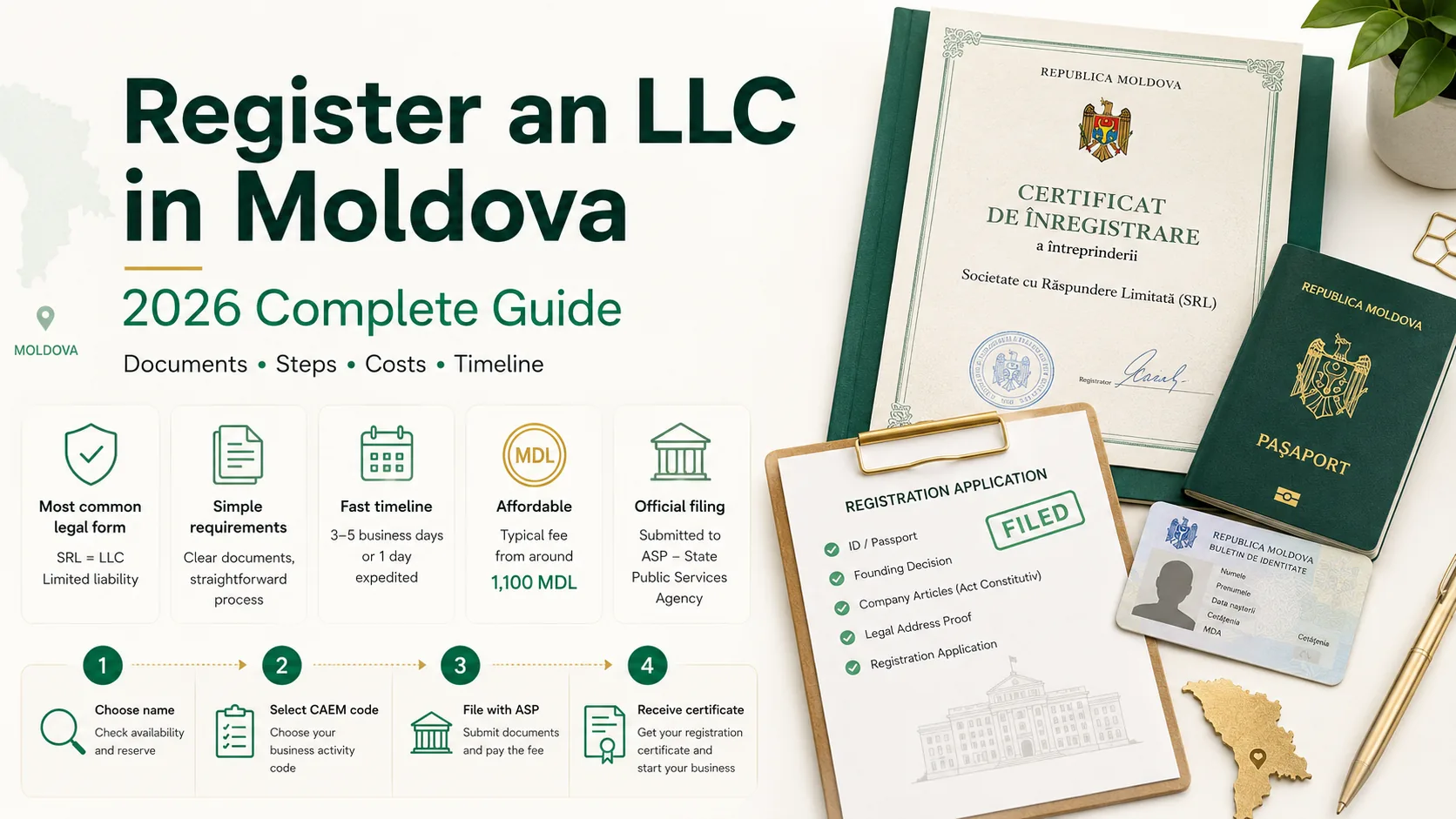
How to register an LLC in Moldova: required documents, steps, costs from 2,000 MDL, ~3-day timeline, share capital, and tax advantages. Full company formation guide.
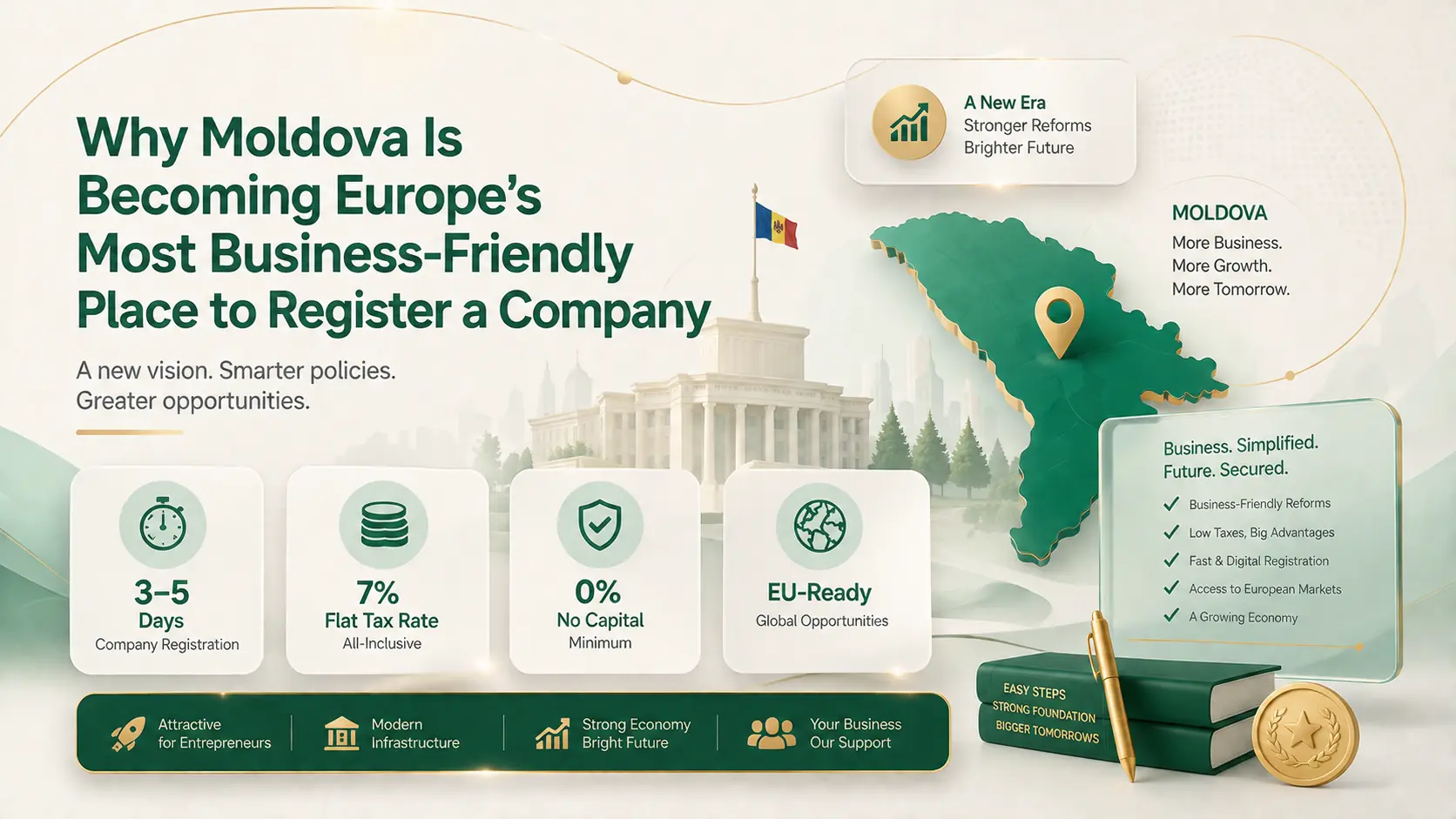
What Moldova's 2026 'European Economy, Efficient State' reform plan changes for registering a company — and why it is already a fast, remote-friendly place to start.
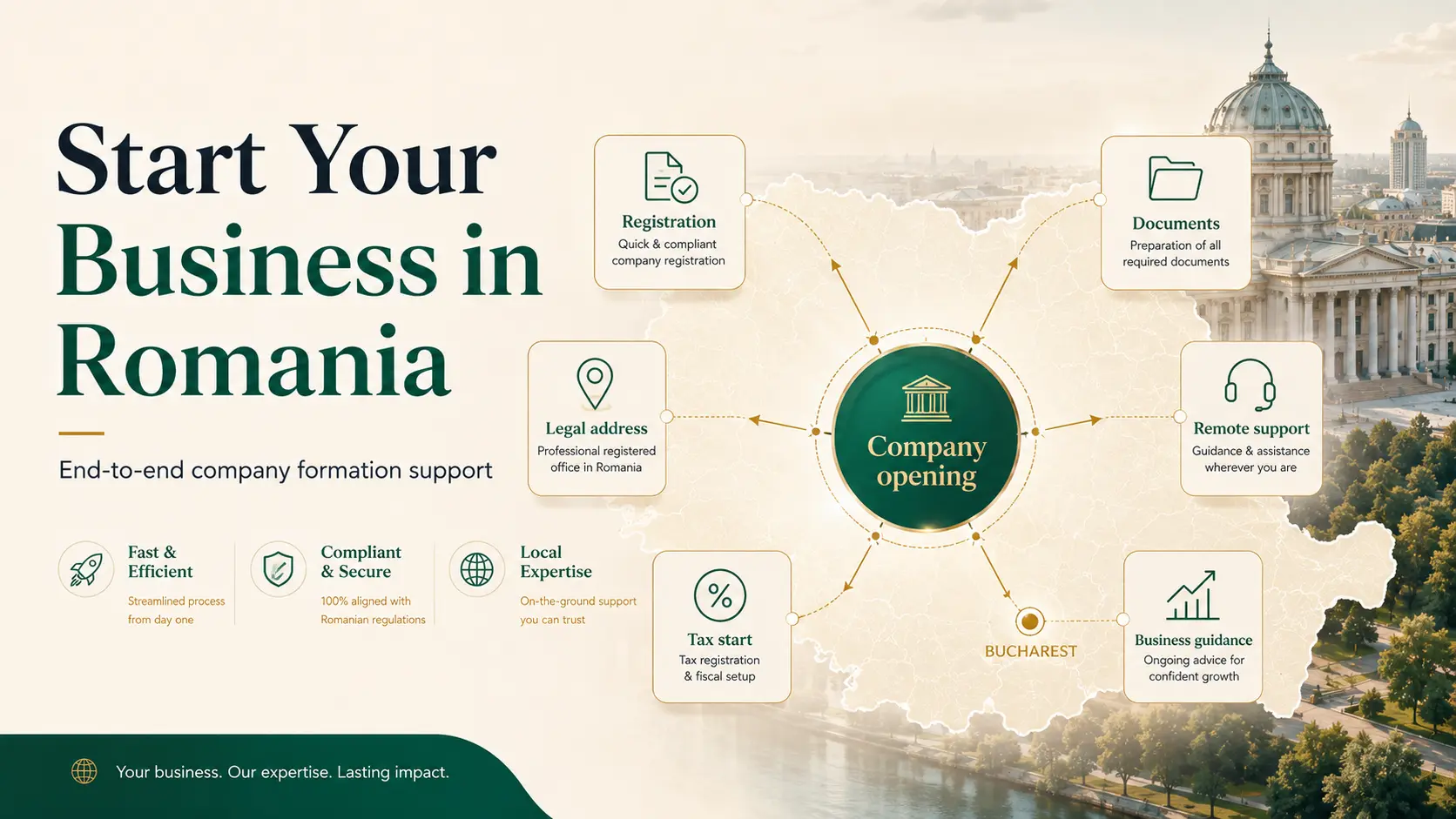
What a Romanian company actually adds, which reasons stopped being true in 2026, and what an SRL costs — whether you are starting out or already trading.