Complete Guide: How to Register an LLC in Moldova in 2026
How to register an LLC in Moldova: required documents, steps, costs from 2,000 MDL, ~3-day timeline, share capital, and tax advantages. Full company formation guide.
 DeschideCompanie
 Taxes and the real cost of employing people in Moldova, Romania, Ukraine, Estonia, Latvia, Lithuania and Poland, compared with every figure sourced.

The question we get most often from a founder looking at Moldova goes something like this: what is the tax rate?
The honest answer is “it depends” — 12% on profit, or 4% on turnover if you stay under the VAT threshold, and the choice between them comes down to your margin. But usually the founder remembers 12%, writes it down next to 16% for Romania and 19% for Poland, and that is where the conversation about money ends.
The trouble is that for a small services company, the corporate tax rate is close to the least important figure in the whole calculation. It applies to profit, which is what is left at the end, and only if anything is left. Salaries are paid every month regardless.
So let us start with the part that does not suit us: Moldova is not the lowest-tax country in the region. Romania taxes turnover at 1% under its micro-enterprise regime for revenue below EUR 100,000 a year (PwC). Estonia does not tax profit at all while you keep it in the company (PwC), and Latvia works the same way (PwC). Three regimes that beat our 12% outright.
And yet, for most of the companies that come to us, Moldova works out cheaper. The reason lies elsewhere.
An employee costs around EUR 5.71 an hour here, total cost to the employer. The same hours cost EUR 13.6 in Romania, 16.3 in Latvia, 17.8 in Lithuania, 19.1 in Poland and 21.1 in Estonia (Eurostat, lc_lci_lev, 2025 data).
The Eurostat figures are published. Ours is not — Eurostat covers member states only, so we reconstructed it: the average gross wage of MDL 15,987.1 for Q1 2026 (NBS), plus the employer’s 24% contribution (PwC), divided by 173.8 hours a month (40 hours a week, the maximum under art. 95(2) of the Labour Code as cited by the State Labour Inspectorate), converted at the NBM rate for 16.08.2026. Treat it as an order of magnitude, not as official statistics.
The gap between tax rates is measured in percentage points. The gap in the cost of people is measured in multiples.
| Country | Corporate tax | Small companies | VAT | Dividends | Employer contributions | Average gross wage |
|---|---|---|---|---|---|---|
| Moldova | 12% | 4% on income, non-VAT SMEs | 20% | 6% | 24% | ~EUR 800 (Q1 2026) |
| Romania | 16% | 1% on turnover, below EUR 100,000 | 21% | 16% | 2.25% | ~EUR 1,824 (June 2026) |
| Ukraine | 18% | 5% on income, Group 3 | 20% | 5% | 22% | ~EUR 601 (May 2026) |
| Estonia | 0% retained / 22% distributed | abolished in 2025 | 24% | included in the rate | 33.8% | EUR 2,135 (Q1 2026) |
| Latvia | 0% retained / 20% on distribution | 15% + 6%, individual shareholders only | 21% | 20% nominal, ~25% effective | 23.59% | EUR 1,831 (Q1 2026) |
| Lithuania | 17% | 7%; 0% for the first two years only | 21% | 15% | 1.77% | unverified |
| Poland | 19% | 9% for “small taxpayers” | 23% | 19% | 20.48% | ~EUR 2,220 (Q1 2026) |
A few things without which the table above misleads.
Latvia shows 20% on paper, but the rate applies to a grossed-up base: the distributed amount is divided by 0.8. Take EUR 100 out of the company and the base becomes 125, the tax 25. Effectively that is 25%, not 20.
Lithuania’s 0% for small companies applies only to the first two tax periods. After that it is 7%. And the Lithuanian average wage is missing from the table entirely, because the national statistics office blocked every automated attempt to reach it, and we do not publish figures we cannot tie to an open source. The Eurostat hourly cost of EUR 17.8 stands in for it below.
Romania’s 2.25% is the work insurance contribution, the only employer-side charge under normal working conditions. The 4% and 8% rates apply only in demanding and special conditions.
The wage figures do not all come from the same month: Romania (June) and Ukraine (May) are monthly values, the rest are quarterly averages. Conversions: Moldovan lei and hryvnia at the NBM and NBU rates for 16.08.2026, Romanian lei and złoty at the ECB reference rates for 14.08.2026.
Look at the employer contributions column. Romania 2.25%, Lithuania 1.77%, Moldova 24%. Read literally, the table says an employee costs ten times less in Bucharest than in Chișinău.
They do not. Romania and Lithuania moved the contributions onto the employee — 35% in Romania, 19.5% in Lithuania, against 9% in Moldova. The total somebody pays is much the same; what changed is whose column it sits in.
At a gross salary of EUR 2,000 a month, it looks like this:
| Country | Monthly cost, employer | Take-home, employee | What the employee gets versus Moldova |
|---|---|---|---|
| Moldova | EUR 2,480 | EUR 1,601 | — |
| Romania | EUR 2,045 | EUR 1,170 | −EUR 431 a month |
| Ukraine | EUR 2,440 | EUR 1,540 | −EUR 61 a month |
| Estonia | EUR 2,676 | EUR 1,535 | −EUR 66 a month |
| Latvia | EUR 2,472 | EUR 1,334 | −EUR 267 a month |
| Lithuania | EUR 2,035 | EUR 1,288 | −EUR 313 a month |
| Poland | EUR 2,410 | EUR 1,360 | −EUR 241 a month |
At identical gross, Romania really is the cheapest. Except that identical gross is not an identical offer: the Romanian employee goes home with EUR 1,170 where the Moldovan goes home with EUR 1,601. That is 27% less, at exactly the same cost to the company.
And people do not choose a job by the gross figure. They look at what lands in their account.
So the right question is what it costs to deliver the same take-home pay:
| Country | Gross needed for EUR 1,601 net | Monthly cost, employer | How much dearer than Moldova | Per year, five people |
|---|---|---|---|---|
| Moldova | EUR 2,000 | EUR 2,480 | — | — |
| Lithuania | EUR 2,487 | EUR 2,531 | +EUR 51 | EUR 3,060 |
| Ukraine | EUR 2,080 | EUR 2,538 | +EUR 58 | EUR 3,480 |
| Estonia | EUR 2,087 | EUR 2,792 | +EUR 312 | EUR 18,720 |
| Romania | EUR 2,738 | EUR 2,799 | +EUR 319 | EUR 19,140 |
| Poland | EUR 2,355 | EUR 2,837 | +EUR 357 | EUR 21,420 |
| Latvia | EUR 2,402 | EUR 2,969 | +EUR 489 | EUR 29,340 |
Romania goes from first place to second-last. That 2.25% advantage disappears entirely the moment you have to compensate the employee for the 35% they pay themselves — and it costs an extra EUR 19,140 a year across a team of five for people to receive exactly the same amount in hand.
The model above deliberately ignores personal allowances, progressive bands and contribution ceilings. It is a like-for-like comparison, not a payroll run. The ordering does not change because of those simplifications; the exact figures do.
Nobody hires at an identical gross across seven countries. You hire at the local market rate. So here is the same team of five, paid each country’s average gross wage, over a full year.
| Country | Average gross | Annual gross, five people | Contributions | Total per year | What you save keeping the team in Moldova |
|---|---|---|---|---|---|
| Ukraine | EUR 601 | EUR 36,060 | EUR 7,933 | EUR 43,993 | Ukraine is EUR 15,527 a year cheaper |
| Moldova | EUR 800 | EUR 48,000 | EUR 11,520 | EUR 59,520 | — |
| Romania | EUR 1,824 | EUR 109,470 | EUR 2,463 | EUR 111,933 | EUR 52,413 a year |
| Latvia | EUR 1,831 | EUR 109,860 | EUR 25,916 | EUR 135,776 | EUR 76,256 a year |
| Poland | EUR 2,220 | EUR 133,224 | EUR 27,284 | EUR 160,508 | EUR 100,988 a year |
| Estonia | EUR 2,135 | EUR 128,100 | EUR 43,298 | EUR 171,398 | EUR 111,878 a year |
The same five roles, the same work. A team based in Chișinău rather than Bucharest leaves EUR 52,413 a year in your account. Against Warsaw, more than EUR 100,000. Against Tallinn, EUR 111,878 — Estonia costs nearly three times as much for exactly the same five people.
Over five years, without growing the team at all, the gap against Romania passes a quarter of a million euros.
We have no verified wage for Lithuania, so we do not put one in the table. Its Eurostat hourly cost places it between Latvia and Poland, which is enough to know where the row would fall.
Worth noting that the ordering in this table matches the ordering of Eurostat’s hourly costs exactly. Two entirely different methods, the same sequence — which means the result is not an artefact of how we did the arithmetic.
We are building a calculator that runs this arithmetic on your salaries and headcount. We will link it from here once it is ready. Until then the formula is simple: gross × 12 × headcount × (1 + employer contribution rate).
If the figures above are close to your situation, the registration itself is shorter than you would expect: an LLC is registered in three working days, and we prepare the documents, file the application and open the bank account. The steps, required documents and costs are set out in the guide to registering an LLC in Moldova.
The standard regime is 12% on profit. We have written at length about every tax obligation a Moldovan company carries in the 2026 guide to taxes and fees; here I stick to what matters for the comparison above. For micro, small and medium enterprises there is also a deferral that counts if you reinvest: tax on profit from the 2023–2026 periods is deferred for as long as you do not distribute dividends, and becomes payable on distribution. The conditions are no more than 249 employees and either turnover or assets below MDL 100 million. From 2026, trading companies with more than 49 employees and turnover or assets above MDL 50 million drop out of the scheme (Ministry of Finance). It is a deferral rather than an exemption, and what happens after 2026 has not been settled publicly.
There is a second regime, at 4%, which many founders hear about first and choose without doing the arithmetic. The 4% applies to “aggregated income determined for accounting purposes” (PwC) — meaning turnover, not profit. The basic condition is that you are not VAT-registered, and since registration becomes mandatory above MDL 1.7 million of turnover from 1 March 2026, the regime is capped in practice at roughly that level, around EUR 85,000 a year. There is also a rule people trip over: if a shareholder holds more than 25% in more than three such companies, at least one of them must move to 12%.
Which works out cheaper depends entirely on your margin. 4% of turnover equals 12% of profit exactly when profit is one third of turnover. Below a 33% margin you pay less on the standard regime; above it, on the 4% one. At a turnover of MDL 1.5 million:
| Margin | Profit | Tax at 12% | Tax at 4% | What you save, and on which regime |
|---|---|---|---|---|
| 15% | MDL 225,000 | MDL 27,000 | MDL 60,000 | MDL 33,000 on the standard regime |
| 33% | MDL 495,000 | MDL 59,400 | MDL 60,000 | MDL 600 — effectively level |
| 55% | MDL 825,000 | MDL 99,000 | MDL 60,000 | MDL 39,000 on the 4% regime |
What overturns the calculation is the deferral above. If you are an SME, do not distribute dividends and reinvest, the profit tax is deferred — so 12% of undistributed profit means nothing to pay now, while 4% of turnover is due whether you profit or not. For a growing company keeping its money inside, the standard regime is almost always the answer. If the interaction between the two regimes matters in your specific case, we check it directly — it is not something to settle from an article.
The rule of thumb we usually give: high margin, few costs and money taken out year after year, look seriously at the 4%. Salaries, a thin margin, or reinvestment, stay on 12%. And whichever you choose, dividends are taxed at 6% on distribution (PwC).
IT Park is 7% of sales revenue, a single tax replacing corporate tax, payroll tax, social and health contributions and a range of local charges. You pay the higher of 7% of revenue or a minimum per employee equal to 30% of the forecast national average wage — MDL 5,220 per employee per month in 2026 (PwC, Moldova IT Park). We covered eligibility in detail in the IT Park guide.
Industrial parks are where most of the confusion sits, because the name sounds like a tax break and it is not one. What you get there is land and infrastructure: a below-market statutory price on land you buy, reduced rent on state land, connection to the park’s utilities. What you do not get is a lower tax rate. If you manufacture something and need premises with utilities brought in, it matters; if you were looking for an exemption, it is not there.
Free economic zones, the one genuinely fiscal instrument for manufacturing, are closed to newcomers. Residents registered before 31 December 2023 keep the right to manufacture, sort and trade externally under the preferential regime until 2034. Anyone registering from 1 January 2024 onward is limited to wholesale trade and auxiliary services — manufacturing is no longer on the list (PwC). In short, a foreign manufacturer looking at Moldova in 2026 has no special tax regime for production available. If somebody tells you otherwise, ask them for the article of law.
We prefer to say this before the contract is signed rather than after.
A Moldovan company is not established in the European Union. Goods heading into the EU remain imports and cross a customs border, with the paperwork and time that entails. The free trade agreement removes duties on most products and common transit has simplified the formalities considerably, but the border is still there. If you sell physical goods into the EU and your logistics depend on frequent deliveries, an entity in a member state will save you more than the salary here does. We covered the trade context separately.
Registration and opening a bank account have their own steps, which we have described separately in the guide for foreign founders and the bank account guide. Both are worth reading before you set your timeline, because that is usually where the delays come from.
Moldova works well where people are the main cost and the product crosses the border down a cable rather than in a truck: services, software, R&D, design, support, accounting — any team working from here and selling elsewhere. That is where the EUR 52,000 a year difference against Romania actually shows up in the account.
The registration itself is not the hard part. An LLC is registered within three working days of a complete filing, and we handle the whole chain: choosing the legal form, drafting the constitutive documents, CAEM activity codes, the registered address, filing with the Public Services Agency and opening the bank account. For foreign founders we also prepare the IDNP and the power of attorney, so you do not discover halfway through that a document is missing.
If your work is IT, software or R&D, we check whether you qualify for IT Park and handle the application — there the 7% replaces payroll tax and contributions too, which changes the calculation above completely.
After registration we stay on the accounting and the people side: payroll, contracts, monthly filings. In practice, everything that makes up the cost we compared in this article.
Tell us three things — what the business does, how many people you are hiring and where your clients are — and we will give you a figure for your situation rather than an average. All services, with prices, on the corporate services page.
All rates and salaries in this article were verified against the primary sources linked in the text, as at this date. Tax rates change, sometimes mid-year. The figure of EUR 5.71 per hour for Moldova is derived by us from verified data rather than published by a statistical authority, and is marked as such everywhere it appears.
This article is informational and does not constitute tax or legal advice. Before any decision to incorporate or relocate, check the figures with an adviser in the jurisdiction that concerns you.
No. Romania taxes turnover at 1% under its micro-enterprise regime for annual revenue below EUR 100,000, and Estonia and Latvia do not tax profit at all while it stays inside the company. Moldova charges 12% on profit. Moldova's advantage shows up in the total cost of employing people, not in the tax rate.
We derived it; it is not published anywhere in that form. The average gross wage of MDL 15,987.1 (Q1 2026, National Bureau of Statistics), multiplied by 1.24 for the employer's 24% contribution, divided by 173.8 working hours per month, and converted at the National Bank of Moldova rate of 19.9819 MDL per euro on 16.08.2026. Eurostat publishes this measure only for EU member states, so no official equivalent exists for Moldova.
Because Romania puts the contributions on the employee: 2.25% employer against 35% employee. Moldova is the reverse, 24% employer and 9% employee. The money has not disappeared, it has simply moved column. At the same gross salary a Romanian employee takes home considerably less, so the gross has to rise to reach an equivalent offer.
At the local average wage, including employer contributions: roughly EUR 59,520 in Moldova, 43,993 in Ukraine, 111,933 in Romania, 135,776 in Latvia, 160,508 in Poland and 171,398 in Estonia. Lithuania is absent because its average wage could not be confirmed against a primary source.
Land and infrastructure advantages: a below-market statutory price on land you buy, reduced rent on state land, and connection to the park's utilities. It is not a reduced tax rate. If you need production space and utilities brought to the site it matters; if you were looking for a tax exemption, it is not there.
In practice, no. Residents registered before 31 December 2023 keep the right to manufacture under the preferential regime until 2034, but anyone registering from 1 January 2024 onward is limited to wholesale trade and auxiliary services. Manufacturing is no longer on the list, so a foreign manufacturer arriving now has no special tax regime for production available.
It depends on your margin. The 4% applies to aggregated income, meaning turnover, while the 12% applies to profit. They are equal exactly when profit is one third of turnover. Below a 33% margin the standard 12% regime is cheaper; above it, the 4% regime is. The 4% regime also requires that you are not VAT-registered, which caps it in practice at the MDL 1.7 million threshold. And if you reinvest profit without distributing dividends, the 12% is deferred — the 4% on turnover is payable either way.
We register the company, handle the accounting, and take care of the people side — contracts, payroll, filings. If you just want a number for your own situation, tell us what the business does, how many people you are hiring and where your clients are, and we will work it out.
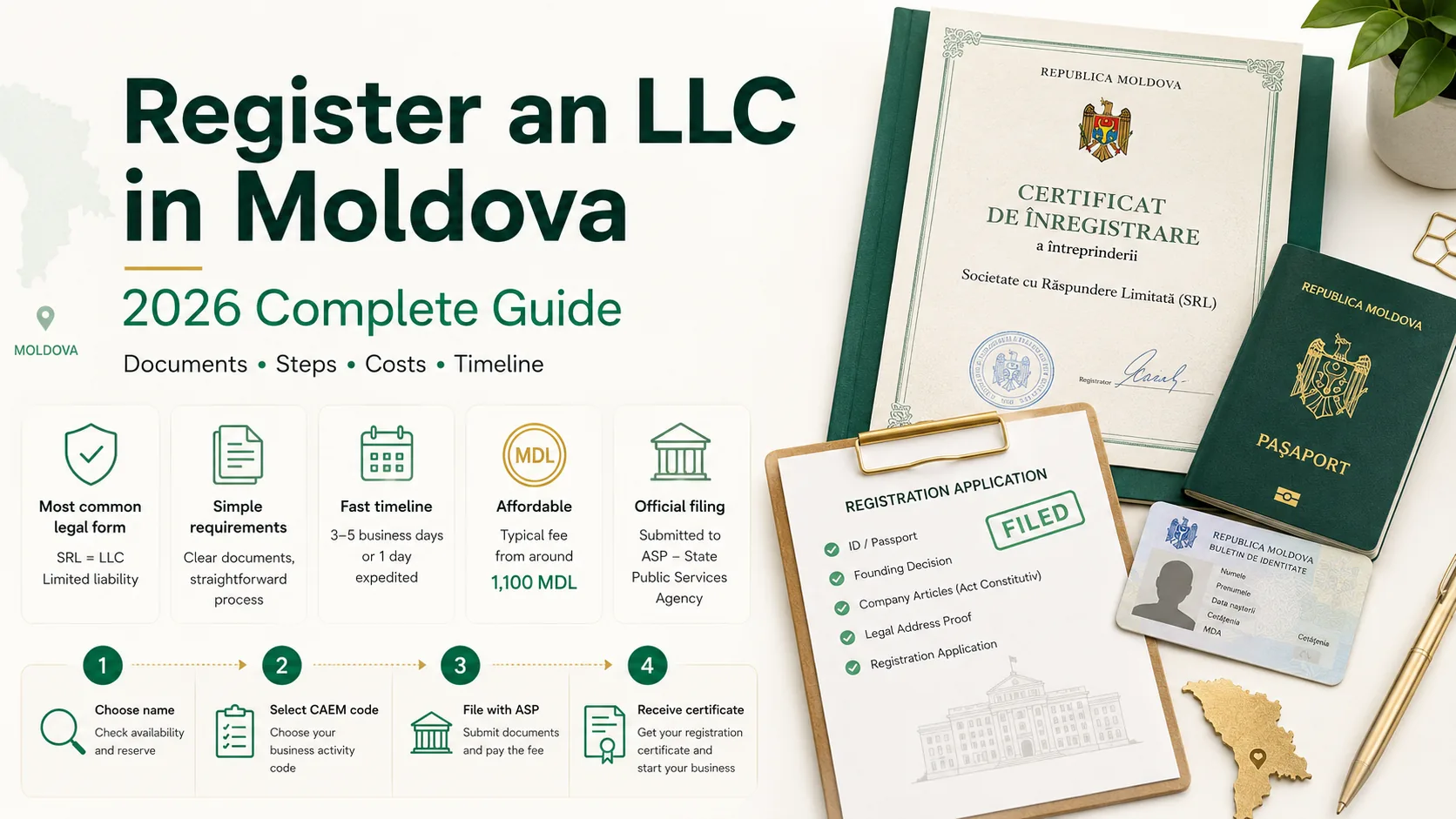
How to register an LLC in Moldova: required documents, steps, costs from 2,000 MDL, ~3-day timeline, share capital, and tax advantages. Full company formation guide.
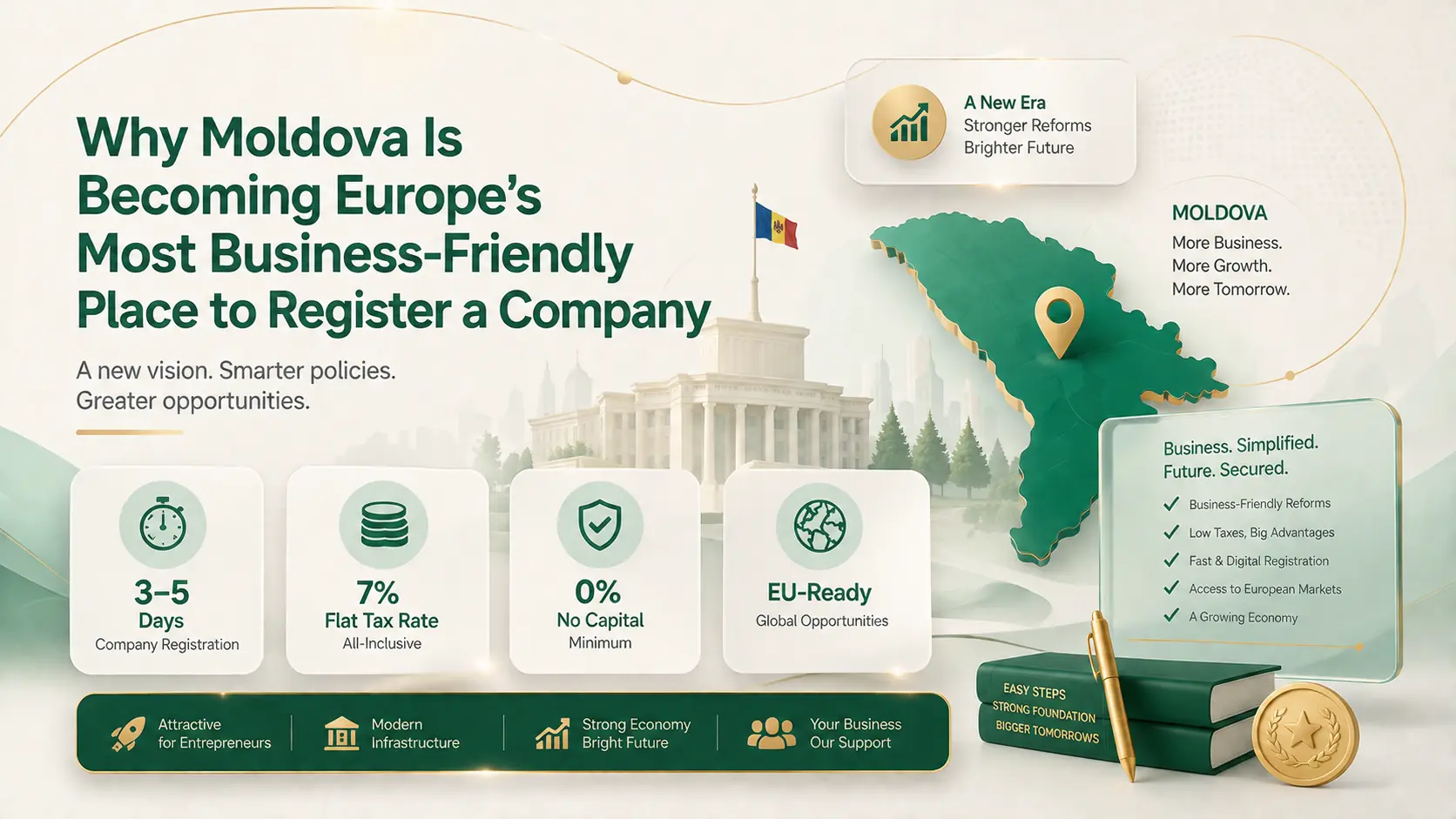
What Moldova's 2026 'European Economy, Efficient State' reform plan changes for registering a company — and why it is already a fast, remote-friendly place to start.

What a Romanian company actually adds, which reasons stopped being true in 2026, and what an SRL costs — whether you are starting out or already trading.